THE PHILIPPINES IN PRESERVING HUMAN VOICES AND FACES
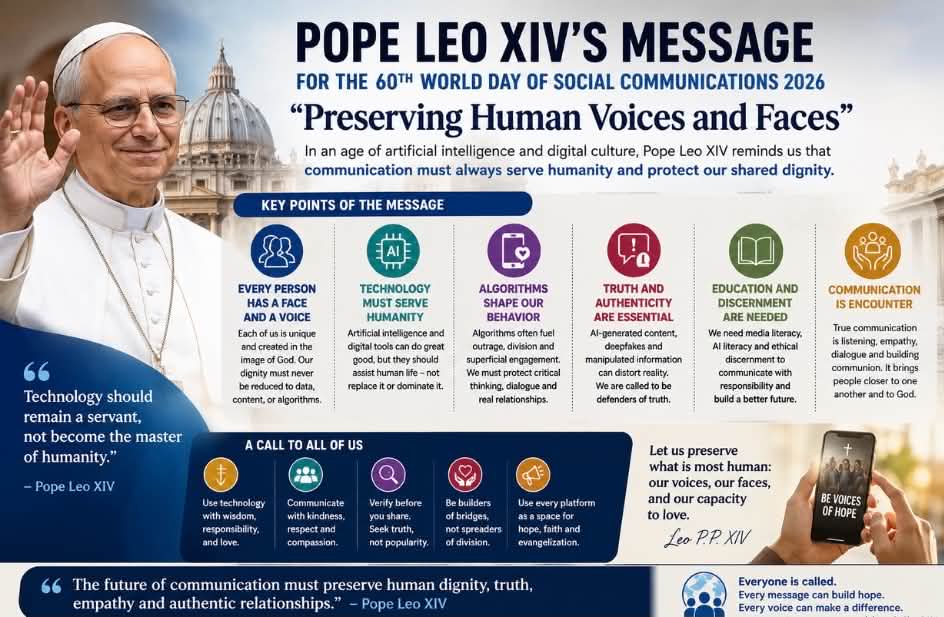
On January 24, 2026, during the feast day of St. Francis de Sales, the patron saint of journalists, Pope Leo released his message for the 6Oth World Communications Day which highlights the uniqueness and sanctity of human voices and faces. He also emphasized the preservation of human identity and dignity in the digital age, particularly on the rising use of artificial intelligence.
At present, where is the Philippines in preserving the human voices and faces?
The Philippines, being one of the largest Catholic countries in the world, has responded actively and positively to Pope Leo's message for the 60th World Day for Social Communications titled, "Preserving Human Voices and Faces." The Philippines' response includes the following:
INTENSIFIED CHURCH LEADERSHIP AND CATHOLIC MEDIA GROUPS AND DISCUSSIONS
The Filipino bishops, diocesan communications offices, media group and Catholic schools have echoed Pope Leo's warning that technology should "serve the human person, not replace it." The different Catholic organizations in the country heightened the discussions and implementations of ethical use of AI, intensified campaigns against misinformation and fake news, responsible use of social media and preserving authentic human relationships online. The Philippines being regarded as among the highest social media user in the world now takes the center stage in modern evangelization with the presence of numerous digital evangelizing groups and pages, but must take serious steps in elevating the responsible and conscientious on the use of it.
STRENGTHENING MEDIA LITERACY EFFORTS
The need for “Media and Artificial Intelligence Literacy” was emphasized by Pope Leo aiming to assist people critically understand algorithms and online manipulation. Here in the Philippines, Catholic schools administered by Diocesan priests and different religious congregations have been promoting digital citizenship, fact-checking, ethical journalism and responsible online communications and information dissemination. Which closely aligns with the Pope’s call for education and discernment.
FILIPINO PARTICIPATION IN VATICAN COMMUNICATION
The Philippines has a visible global role in Church communications. Many Filipino Church leaders continue to influence international Catholic communication efforts such as Luis Antonio Cardinal Tagle , the Pro-Prefect of the Dicastery for Evangelization who continue to influence Catholic communication efforts internationally and with San Pablo Bishop Marcelino Antonio Maralit Jr. as member of the Vatican’s Dicastery for Communication.
PUBLIC CONCERN ABOUT AI AND MISINFORMATION
The concern of the Pope regarding AI-generated voices, fake images and manipulated content reflects issues which have already affected the Philippine society such as cyberbullying, deepfakes, online trolling and political disinformation. The Pope’s message have been connected to these local realities by some Filipino commentators and Catholic communicators, especially during public debates and election periods.
FOCUS ON “HUMAN-CENTERED COMMUNICATION
Pakikipagkapwa-tao (human solidarity and shared humanity) has long been emphasized by Filipino Catholic communities which resonates Pope Leo’s call to preserve the “face and voice” of every person. Filipino spirituality highly values compassion in communication, family connection, personal encounter and storytelling.
Overall, the Philippines has long been responding to Pope Leo’s message not only as a religious teaching but also as an innate and normal way of life of connecting, valuing human relationships and encounter and continually promoting the truth amidst fast and robust technological advancements.