“Go into the whole world and proclaim the Gospel to every creature.”
-Mark 16:15 (NABRE)-
These words of Jesus are not only a command to His first disciples—they are also a mission entrusted to all of us today. Even as He ascended into heaven, Christ sent His followers into the world to share the Good News. And today, that “world” includes the digital space.
The Church continues to find ways to bring the Gospel to people wherever they are—even on our screens. Whether through social media, livestreams, podcasts, or online communities, the mission remains the same: to proclaim Christ.
But did you know that long before TikTok, Facebook, YouTube, or podcasts existed, the Church already recognized the power of communication?
During the Second Vatican Council, the Church was called to open its doors to the modern world through a process of “updating” (aggiornamento). This renewed vision led the Church to find new and clearer ways to communicate the Gospel.
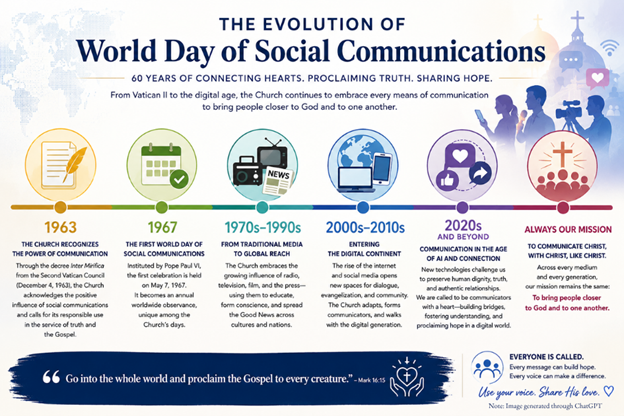
One important fruit of this renewal is a document called Inter Mirifica, which means “Among the Wonderful.” Promulgated by Pope Paul VI on December 4, 1963, it is the Church’s first document entirely focused on social communications. Even though it was written long before the internet, its message remains relevant today.
Inter Mirifica teaches us that media and communication are gifts from God. When used well, they can help spread truth, educate minds, build unity, and share the Gospel. But the Church also reminds us that these same tools can be misused—to spread lies, hatred, division, and immorality. Because of this, Pope Paul VI encouraged the Church to reflect deeply on the role of media. He called for an annual celebration dedicated to promoting awareness, prayer, and support for social communications.
This became what we now celebrate as the World Day of Social Communications, first observed in 1967 with the theme “The Church and Social Communication.”
In his message, Pope Paul VI recognized the growing influence of communication tools—from newspapers and radio to television and emerging technologies of his time. He believed that the Church must actively engage these platforms for evangelization, truth-telling, moral formation, and the promotion of unity and human dignity.
He also called on everyone—journalists, educators, parents, public leaders, and especially young people—to use media responsibly and ethically. For those working in media, he reminded them of their mission: to become instruments of truth, goodness, peace, and respect for human dignity.
Through the years, the celebration has continued to evolve. From traditional media like print, radio, and television, we have now entered a world of digital media—social networks, influencers, artificial intelligence, and beyond. Yet the message remains the same: to proclaim the truth with charity.
Today, the Church continues to guide us in facing modern challenges such as misinformation, digital responsibility, online behavior, and the ethical use of technology. The Church sees communication not just as a tool, but as a powerful force that shapes culture, relationships, public opinion, and even faith. That is why we are all called to use media with responsibility—and with purpose.
The World Day of Social Communications reminds us that every Catholic communicator—whether a professional journalist, a student, a volunteer, or a simple content creator—has a mission. We are not only called to inform. We are called to inspire.
In a world filled with noise and confusion, the Church invites us to become voices of truth, hope, and communion.
As Catholics present in the digital world, we are invited to become responsible digital missionaries—sharing only what is true, good, and beautiful. Because in every post, every message, and every story we share, we have the chance to proclaim Christ.
_______________________
Flor Cagas – Core Team, Social Communications Ministry
Sources: